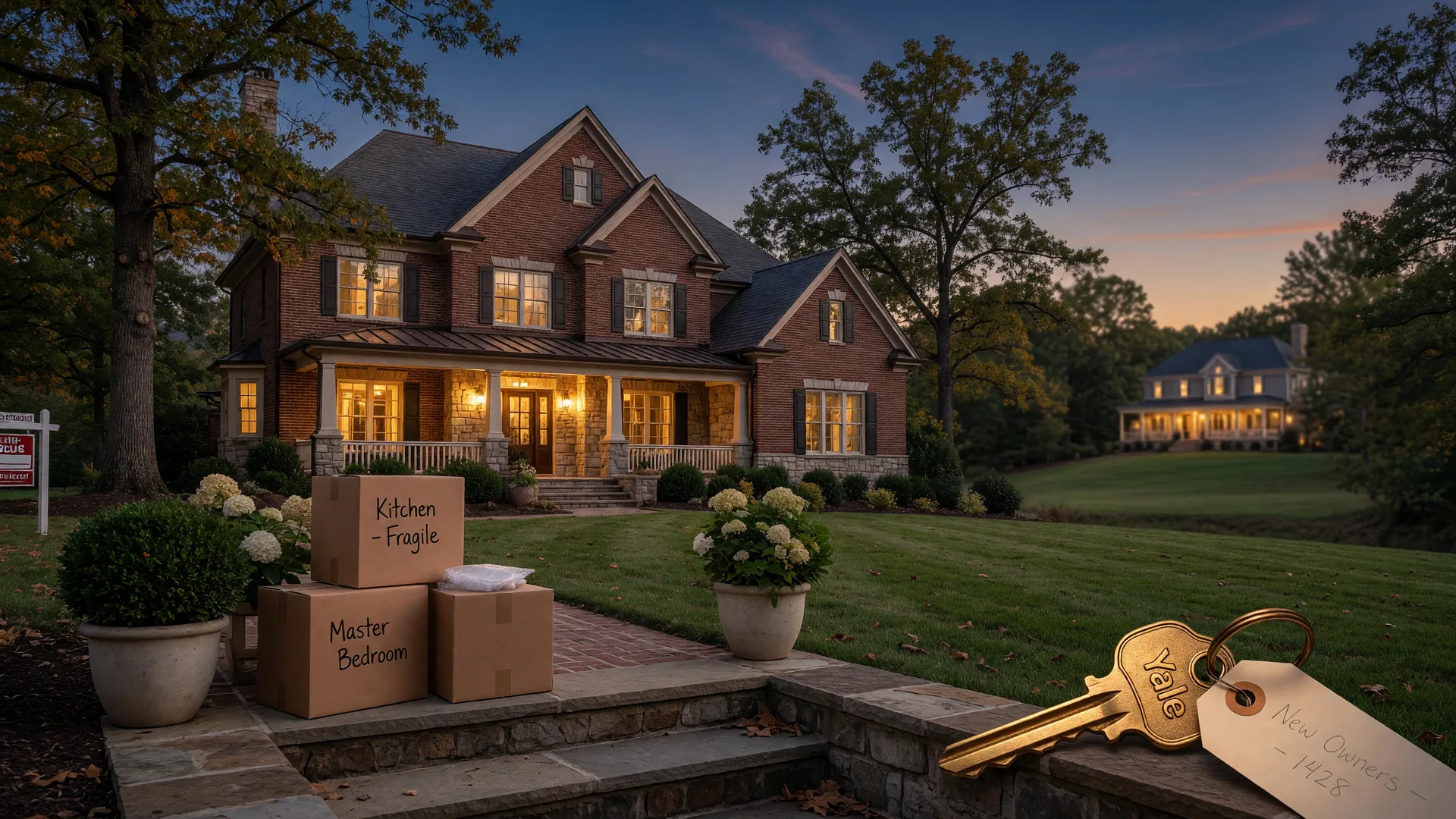
Your offer on the new home is in, and your current house has not sold yet. That is the moment most Knoxville sell-buy homeowners fear, and the answer is not panic, it is structure: what your contract actually protects, the three paths when the window is running out, and the fall 2026 numbers on each. Here is exactly what happens, and how a good plan keeps a slow sale from costing you the right home.
First, the market context: Knoxville sales are taking longer
This scenario is more common in fall 2026 than it was in 2024 or 2025, simply because the market is slower. Knoxville-area homes are averaging roughly 54 days on market at the metro level (FRED, June 2026), up from 48 days a year earlier, with Redfin's city reading near 52 days. Supply has climbed to roughly 3.9 months, the closest this market has come to balance in years, with about 3,600 active listings in the metro as of August. A balanced market is healthy, but it means the days of a can't-miss listing selling in a weekend are over for most homes. Plan on the reality: listing to closing takes 60 to 90 days even when everything goes right, and that is exactly the window your new purchase has to survive.
Rates make the timing sharper. Freddie Mac's Primary Mortgage Market Survey for the week ending September 24, 2026 put the 30-year fixed at 7.03 percent, up from 6.95 percent the prior week and 6.30 percent a year earlier, after the Federal Reserve raised its funds rate target to a 3.75 to 4.00 percent range on September 16 and prime followed to 7.00 percent. When borrowing costs are pressing upward, a rate lock is a perishable asset: if your sale runs long and your lock expires, the same home costs more. That is one more reason to build the sell-buy timeline with margin and to know your out before the deadline.
What the contract actually protects
Most Knoxville buyers in a simultaneous move write their offer with a home-sale contingency: the purchase depends on your current home selling within an agreed window, typically 30 to 60 days. If the window passes without a sale, the contract gives you the right to terminate and your earnest money, typically 1 to 3 percent of the purchase price, comes back. That is the protection, and it is real. Most agreements also carry a kick-out clause: if the seller receives a non-contingent backup offer, they can give you 24 to 72 hours to waive your sale condition or step aside.
The line to remember: a contingency protects your earnest money if the sale does not happen in time. It does not protect your rate lock, your moving plans, or the home you wanted. It buys you a clean exit, not a guaranteed win.
The moment people get hurt is when the deadline passes with no action. If you waive the contingency and then cannot perform, or if you simply miss the window to terminate, you are on the hook, and backing out then can cost you the earnest money. The contingency only protects you while it is active, and it only protects you if you act inside its window. That is why the first thing I do on every sell-buy file is put the contingency deadline and the kick-out terms on paper before we write a single offer.
The three paths when the window is running out
When your home has not sold and the deadline is closing in, there are exactly three moves. Choosing correctly is the whole game.
Path one: extend and negotiate. Ask the seller for more time, and make the extension earn its keep: raise your earnest deposit, tighten your financing contingency, offer a flexible or earlier closing date. Sellers in Knoxville's 3.9-month-supply market are more willing to wait than they were two years ago, especially when your home is already under contract and the delay is a closing-date issue, not a no-buyer issue. An extension is cheap when the deal is real.
Path two: bridge the gap. Tap your equity so the new close happens on schedule and your sale repays the money when it funds. A HELOC at roughly 7.1 to 7.5 percent in late September, or a bridge loan at roughly 7 to 12 percent plus points, turns a contingent offer into a clean one and removes the seller's reason to worry. This is the path when the new home matters and the equity is there.
Path three: walk, reset, and relist. Exercise the contingency, get your earnest money back, and take a hard look at why the house has not sold: price, condition, photos, feedback. Sometimes the right move is losing this house to win the sale of your current one. The contingency exists precisely so walking away is a strategy, not a loss.
Bridging the gap with fall 2026 numbers
If the house matters and the equity is real, the gap is a financing question. A HELOC is the leanest option: late-October 2026 national averages run around 7.36 percent (Bankrate) with Curinos near 7.67 percent, and you pay interest only on what you draw. Your payment while you sell is small, and the line is repaid in full when the sale closes. Fixed-rate home equity loans were running around 8.6 percent in October for buyers who want a set payment on a set amount.
A traditional bridge loan is the expensive option: commonly 7 to 12 percent plus 1 to 2 points, with industry averages recently near 11 percent, because the lender expects a lump-sum repayment from your sale within 6 to 12 months. Most borrowers fall in the 9 to 11 percent range on an interest-only or payment-deferred basis. In between sits an equity-unlock program, where a partner advances a portion of your equity for a convenience fee in the low single digits, repaid at closing, which makes your offer look like cash without carrying a second mortgage.

One warning that applies to all of it: a bridge or HELOC draw counts against your debt-to-income on the new mortgage, and interest on a HELOC secured by your current home and used for the next one may not be deductible under the current tax rules. I run the specific numbers with every client, and your lender confirms the underwriting treatment before we commit to a path.
A worked example, with the current market baked in
Let us make it concrete. These are illustrative figures, not a quote, but the structure is exactly what we run for clients in this market.
The setup: a $650,000 home in West Knoxville with a $220,000 mortgage payoff, roughly $430,000 of equity. You are under contract on an $875,000 home in Farragut with a 45-day sale contingency, and the down payment plus closing costs come to about $185,000. At week three, your home has showings but no offer.
Path one: the Farragut seller grants a 15-day extension after we raise the deposit from 1 to 2 percent and shorten the financing contingency. At week five, an offer arrives at $642,000, we negotiate to $648,000, and both closings land inside the window.
Path two: no extension available, so we draw $185,000 on a HELOC at about 7.3 percent. Interest-only while you sell runs around $1,125 a month for the six weeks until your sale closes, the sale nets roughly $406,000 after commission, the transfer tax, and settlement costs, and the line is repaid in full. About $1,700 of carrying cost buys you the house and one move instead of two.
Path three: buyer feedback says the price is six percent above where the market sees the home. We release the contingency, get the earnest money back, reset the list price, and the home is under contract within two weeks. You lost the house and bought a faster sale, which was the better outcome all along.
Notice the pattern: every path starts with a decision made before the deadline, in possession of the feedback, the equity number, and the seller's appetite for waiting. That is the difference between a plan and a scramble.
The not-sold-yet playbook: before you ever reach the wire
The best protection is a listing that is actually working. In a market averaging 54 days on market, three weeks of showings without an offer is a signal, not a tragedy. My not-sold-yet checklist: review the buyer feedback from every showing, sharpen the photography and the floor-plan marketing if the walk-throughs are falling off, and test the price against the most recent closed comps, because in a balanced market the listing price is the first thing buyers vote on. A home priced at market with strong presentation is still generating offers in Knoxville; a home sitting at a premium is donating its contingency window to a slow burn.
Two structural levers help from day one. List before you shop, so the contingency has time to work, and negotiate a rent-back on your current sale (most lenders cap post-closing occupancy at 60 days under Fannie Mae and Freddie Mac rules) when the timing still does not overlap. Sellers in a 3.9-month-supply market will consider a rent-back far more readily than they would have in the 2021 sprint. The goal is the same: one move, delivered on schedule, with the sale funding the purchase.
Frequently asked questions
What happens if my current home doesn't sell before my new purchase closes? With a home-sale contingency, you can terminate once the window passes and your earnest money comes back. If you waived the contingency or missed the deadline, you may be obligated to close, and backing out could cost your deposit. Act before the window hits zero: extend, bridge, or walk.
Will I lose my earnest money if the sale falls through? Not if the contingency works as written and you terminate within its window. You risk the deposit when you back out without a valid contingency reason, miss the deadline, or fail to perform after the contingency is released. Review the deadline language before you sign.
How long does a typical home-sale contingency window run in Knoxville? Usually 30 to 60 days with a kick-out clause holding a 24 to 72 hour window to waive or release. In a market where homes average about 54 days on market, plan on 45 to 60 days for a contingent purchase.
What are my options when the contingency window is almost out? Extend and strengthen the offer, bridge the gap with equity at roughly 7.1 to 7.5 percent for a HELOC or 7 to 12 percent for a bridge, or walk, reset the price, and relist. The right path depends on whether your home is under contract and how much the new home matters.
How much does it cost to bridge the gap with a HELOC or bridge loan? A $185,000 HELOC draw at about 7.3 percent runs roughly $1,125 a month interest-only; the same amount on a bridge at about 9 percent is roughly $1,390 a month plus points up front. Both are repaid at your sale closing, and both usually cost far less than losing the home or moving twice.
The Bottom Line
A home that has not sold before your new closing is not a disaster, it is a decision point. In fall 2026 Knoxville, where homes average about 54 days on market and the market is closer to balance than it has been in years, you plan for it the way you plan for any timeline: with margin, with a contingency you understand, and with an equity number computed before you need it. Extend when the deal is real. Bridge when the house matters and the equity is there. Walk when the feedback says the price is the problem. Every path works when you choose it on purpose.
If you are a Knoxville-area homeowner trying to sell and buy at the same time, I will show you the whole structure before you write an offer: your equity, the contingency terms to ask for, the fall 2026 cost of every bridge option, and the plan for the day your home is not sold yet. Thirty minutes, real numbers, no pressure. That is how a simultaneous move should start.
Planning a sell-buy move in Knoxville?
Let us map your equity, your contingency terms, and the fall 2026 numbers on every path, so a slow sale never costs you the right home. Straight talk, no obligation.